About
This website contains simulations for two different world models: a Heliocentric Model using Newton's laws of motion and a Geocentric Model based off of the ideas of ancient Greek philosopher Claudius Ptolemy. In the Heliocentric (Newton) model, the planets orbit the Sun in slight ellipses as a result of forces acting on them and causing them to accelerate. By contrast, the Geocentric (Ptolemy) model has Earth be stationary close to the center of the universe, while all of the other planets and the Sun orbit it in perfect circles.
Newton's Laws
The heliocentric planetary simulation was created by utalizing Newton's three Laws of Motion:
- Objects retain a constant velocity unless acted upon by a force
- \(F = ma\) where \(F\) is the net force acting on an object, \(m\) is the object's mass, and \(a\) is the object's acceleration
- For every force there is an equal force in the opposite direction.
For the Newton simulation, each planet and star had its mass, average distance from Sun, and average velocit recorded. These would serve as the initial positions and velocities, with the velocity directions being perpendicular to the direction towards the Sun.
The simulation runs infinite iterations where it then iterates through all of the planets and stars. For each planet, it calculates the force between it and each of the other planets. The forces are split into x-axis and y-axis components, and then summed up to create a net force. Each individual force between two planets is calculated with the following equation:
\[F = G\frac{m_1m_2}{d^2}\]
Where \(F\) is the force, \(G = 6.6743 \times 10^{-11} \frac{m^3}{kg * s^2}\) is the gravitational constant, \(m_1\) and \(m_2\) are the objects' masses, and \(d\) is the distance between the objects.
From this net force, Newton's second law is utalized to calculate the acceleration of the planet; knowing both the net force and mass finding acceleration is as follows: \(\frac{F}{m} = a\). This acceleration is split up into directional x/y components (the real universe would also have a z component; this is ignored for simplicity but the math is the same) and then is added to the x-velocity and y-velocity of the planet.
With updated velocity values, the planets then all change their position by that amount. More iterations occur and the planets move through the sky!
Simulation Accuracy Notes
While the simulation is based upon mathematically accurate assumptions, there are two important considerations that make it more of an approximation:
- The initial parameters are the average distance and average velocity. It may not be the case that planets have their average velocity occur at the same time as their average distance to the sun; this would thus cause a different orbit than intended.
- To speed up the simulation, rather than waiting for hundreds of iterations to occur one iteration's results are multiplied by a large constant (21600) to have a significantly large displacement. While much thousnds of times faster and still fairly accurate, this can slowly cause the planets to drift away from their original orbit path over time.
Retrograde
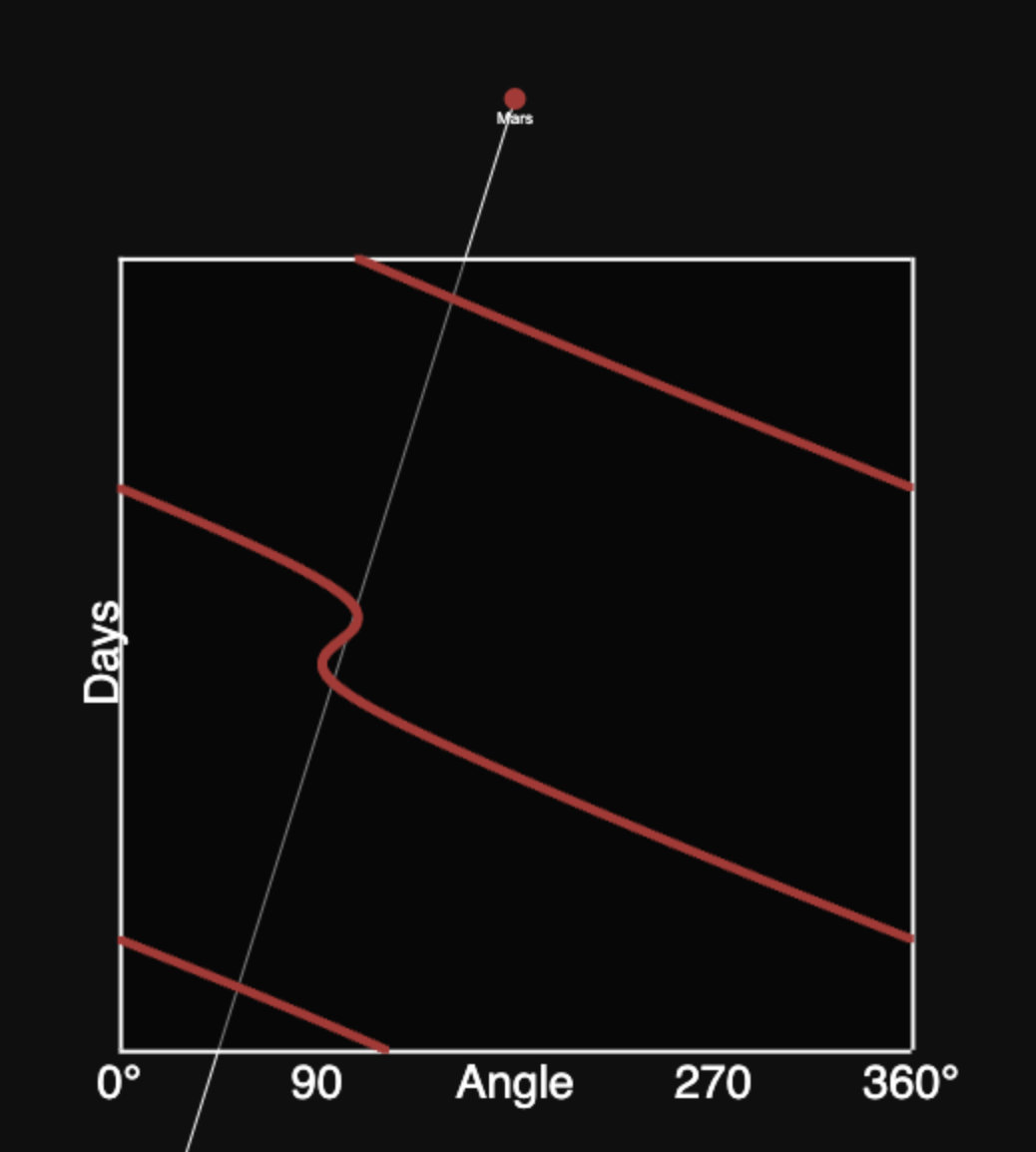
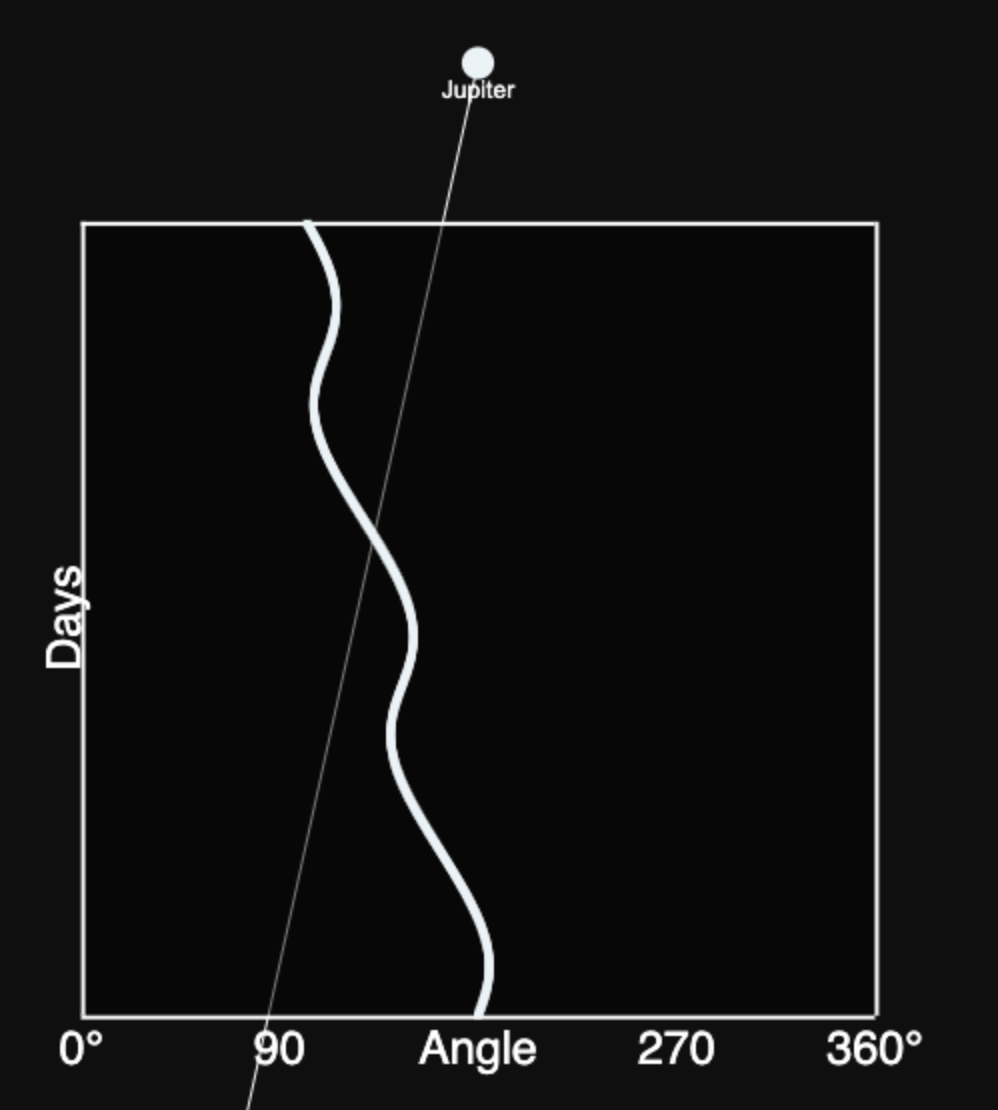
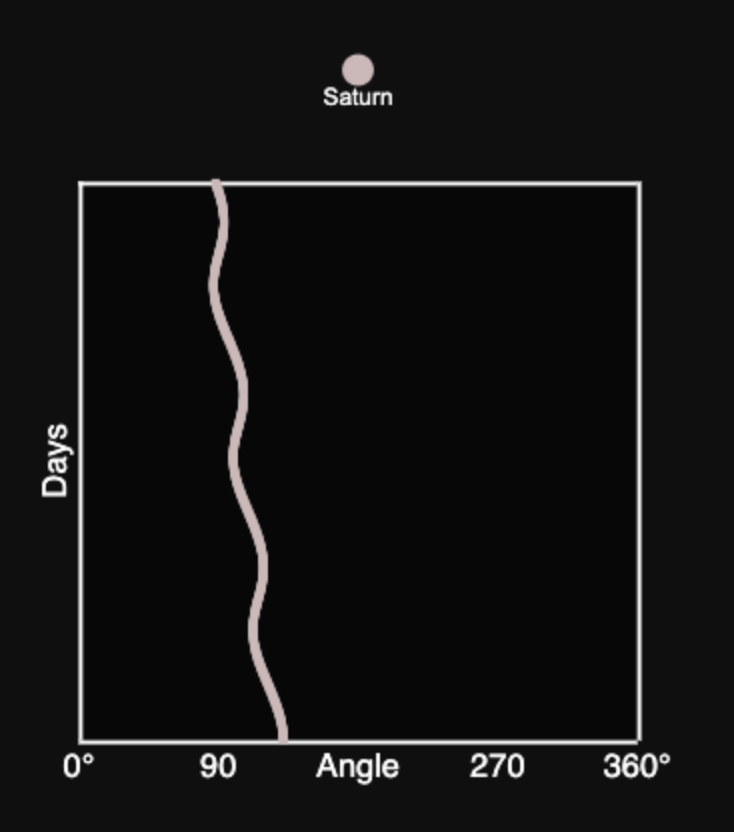
As time progresses, the angle of planets relative to Earth changes resulting in them appearing to move across the sky. Retrograde is an optical illusion where planets appear to temporarily move backwards in the sky relative to Earth, which was challenging to explain with the Geocentric model. Ptolemy's Geocentric model incorporated epicycles into his model which are small sub-orbits whose centers move around the circumference of larger orbit circles in order to approximate retrograde.
Below are diagrams showing the angles of Jupiter, Mars, and Saturn relative to Earth over time. Retrograde occurs when the angle briefly increases (a rightwards shift). Planets closer to Earth experience a greater change in angle over the same period of time.
Parallax
Parallax is the visible shift of an object's position when viewed from different vantage points. Ptolemy, a famous astronomer who lived around 100 AD to 170 AD, could not observe any parallax with the distant stars and reasoned that the Earth likely isn't moving if the stars don't appear to shift at all. However, this assumption was incorrect since in reality Earth really was moving; the lack of visible parallax is due to the fact that all stars besides the Sun are very far away from Earth relative to Earth's orbit diameter.
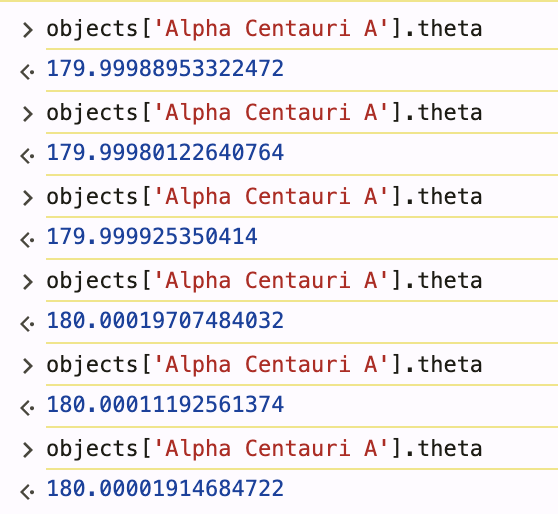
As an example, the second-closest visible star to Earth is Alpha Centauri A at a distance of 4.367 light years, over \(4.13 \times 10^{16}\) meters away while Earth's orbit diameter is only \(3 \times 10^{11}\) meters. This results in Alpha Centauri A's position relative to Earth shifting less than 0.001 degrees - impossible to notice with a bare eye and astronomical measurement devices at the time.
Below are preriodic recordings of Alpha Centauri A's angle relative to Earth in the simulation as Earth completed a whole orbit: